
Sheridan County Tax Record Contents
Sheridan County splits its property tax records across two offices. The Appraiser maintains the annual appraisal roll. That roll holds each parcel's class, land and improvement characteristics, owner and mailing fields, exemptions, tax district, and valuation notice. The Treasurer then handles what that valuation produces. Statements, receipts, installments, and delinquency sit with the Treasurer. Added tax, special assessments, and payment-under-protest records sit there too. When you request copies, name one parcel and one tax year. That keeps figures from different cycles separate.
| Field | What It Shows | Where |
|---|---|---|
| Appraised value | County estimate before the class rate | Appraiser |
| Assessed value | Tax base after the Kansas class rate | Appraiser and roll |
| Property class | Residential, commercial, agricultural, exempt, or other class | Appraiser |
| Statement and status | Charges, installments, payment, or delinquency | Treasurer |
| Tax district and levy | Local taxing units and rate context | Roll, Clerk, and Treasurer |
Assessed value is its own number. It is not market value. It is also not the sale amount recorded on a deed. Kansas applies a class rate to appraised value first. Then the levy and any adjustments turn that into the actual tax. Agricultural land follows separate use-value rules of its own. Remember that a tax statement proves only that a tax record exists for its year. It never proves title, occupancy, or a likely sale price.
Sheridan County Tax Offices
The Sheridan County Appraiser is Mindy Harting. Her office sits on the courthouse second floor at 925 9th Street in Hoxie, reachable at (785) 675-3932 or appr@sheridancoks.com, open weekdays from 8:00 a.m. to 4:30 p.m. This office supplies the account, class, parcel traits, owner and mailing fields, land and improvement values, total appraised value, assessed value, exemption or Neighborhood Revitalization status, the valuation notice, and the roll date. Sheridan County Treasurer Shirley Niermeier works from the same courthouse and PO Box 899. Call (785) 675-3622 or write sdcotreas@sheridancoks.com. Posted hours end at 4:00 p.m. The Treasurer issues statements, receipts, paid or unpaid status, delinquency figures, special assessments, added tax, and protest records. A third office matters too. The County Clerk keeps valuation filings, assessment abstracts, levy records, and county-board material.
Kansas Rates Shape Sheridan Assessments
In Kansas, a property's class decides how appraised value becomes assessed value. Residential real property carries an 11.5 percent assessment rate. Vacant lots sit at 12 percent. Commercial and industrial real property is assessed at 25 percent. Agricultural land gets valued on agricultural use, and it is assessed at 30 percent. Exempt property is not taxed the same way at all. Before you apply any rate, confirm the class. Check the class listed for the parcel on the Sheridan County roll.
| Property class | Assessment treatment | Local check |
|---|---|---|
| Residential | 11.5% of appraised value | Confirm dwelling and parcel class |
| Vacant lot | 12% of appraised value | Check land-use coding |
| Commercial or industrial | 25% of appraised value | Check mixed-use treatment |
| Agricultural land | Use value, then 30% | Ask about land category and method |
The math is simple once you know the pieces. Multiply appraised value by the assessment rate to get assessed value. Then multiply assessed value by the mill levy and divide by 1,000. That gives the base tax before credits or special items. For a real figure, use the official roll and statement rather than a rough estimate.
Classification is a parcel-level fact, not something to guess from how a place looks. A single tract may hold land and improvements. Agricultural value follows a use-based method rather than an estimate of likely sale price. Ask the assessor for the class, land category, appraisal date, and the notice for the year in question. If a number moved, find out what explains it. A market adjustment, a property change, corrected descriptive data, or a class change may be the reason.
Look Up a Sheridan County Tax Bill
The state's Kansas Property Tax Payment application starts by asking for the County Name. You then Continue from there. It wants a property tax statement and a payment method. One warning matters: a single cart cannot hold parcels from more than one county. This is a payment service, not a free assessor card or owner search. Get the right Sheridan statement or account from the county first.
The state payment screen lays out that county-first entry point plainly.
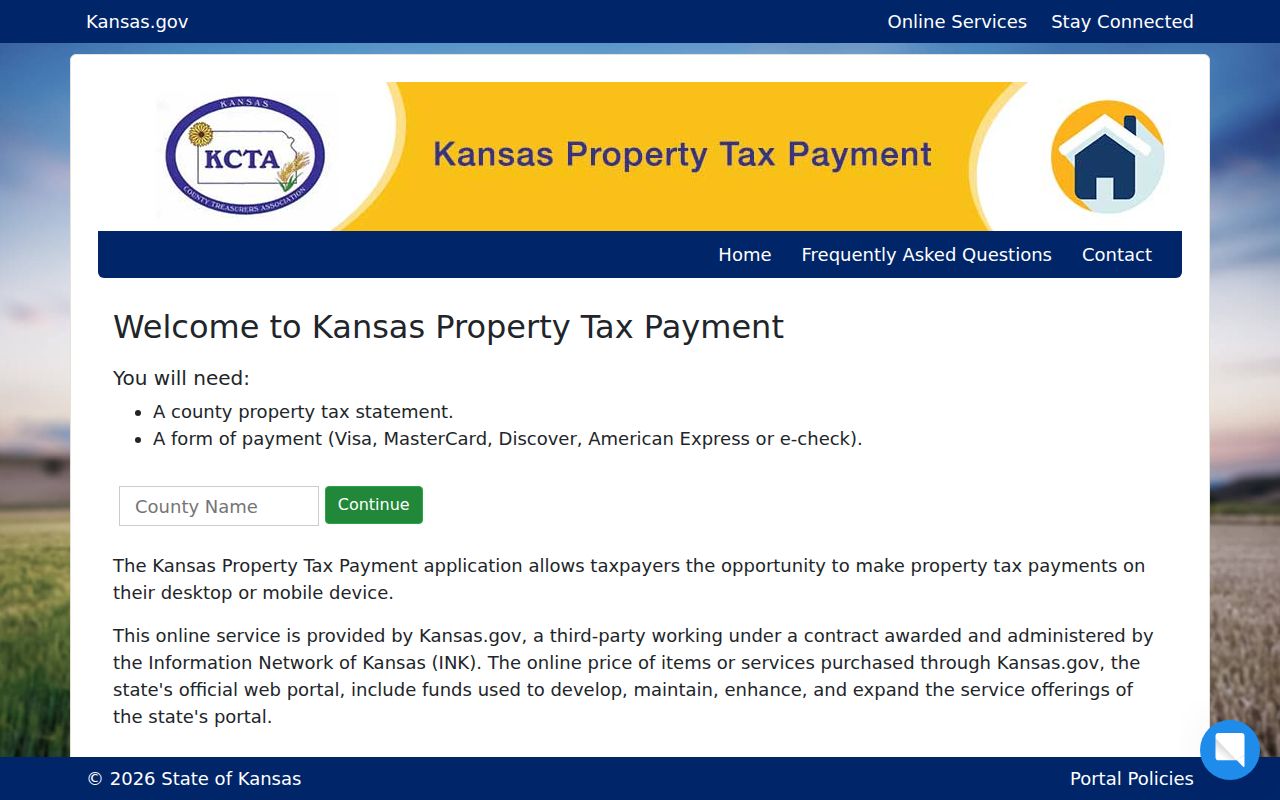
The screen handles payment after statement identification; it does not replace the county's appraisal and tax files.
- Give the Appraiser the situs address and request the account, parcel ID, class, tax district, and valuation year.
- Ask the Treasurer for the statement and existing payment record for that account and year.
- Compare the appraised and assessed values, exemptions, levy, installments, and special items.
- Use the state payment service only after the county and statement match.
- Assessed value
- The taxable base after the class rate is applied.
- Mill levy
- A rate measured per thousand dollars of assessed value.
- Exemption
- A lawful exclusion or reduction that must be confirmed on the record.
- Tax lien
- A legal claim tied to unpaid property taxes.
Sheridan County's 2025 Value Notice
A February 2025 market-study notice reported an overall upward trend. It was inflationary, and it spanned residential, commercial, and vacant-lot property. The notice also flagged that any single parcel could differ. Property changes, descriptive corrections, or comparable-property adjustments can all move one parcel against the trend. That distinction matters. The study describes the market broadly. It does not set a value for one parcel.
The county notice keeps the local wording and date intact.
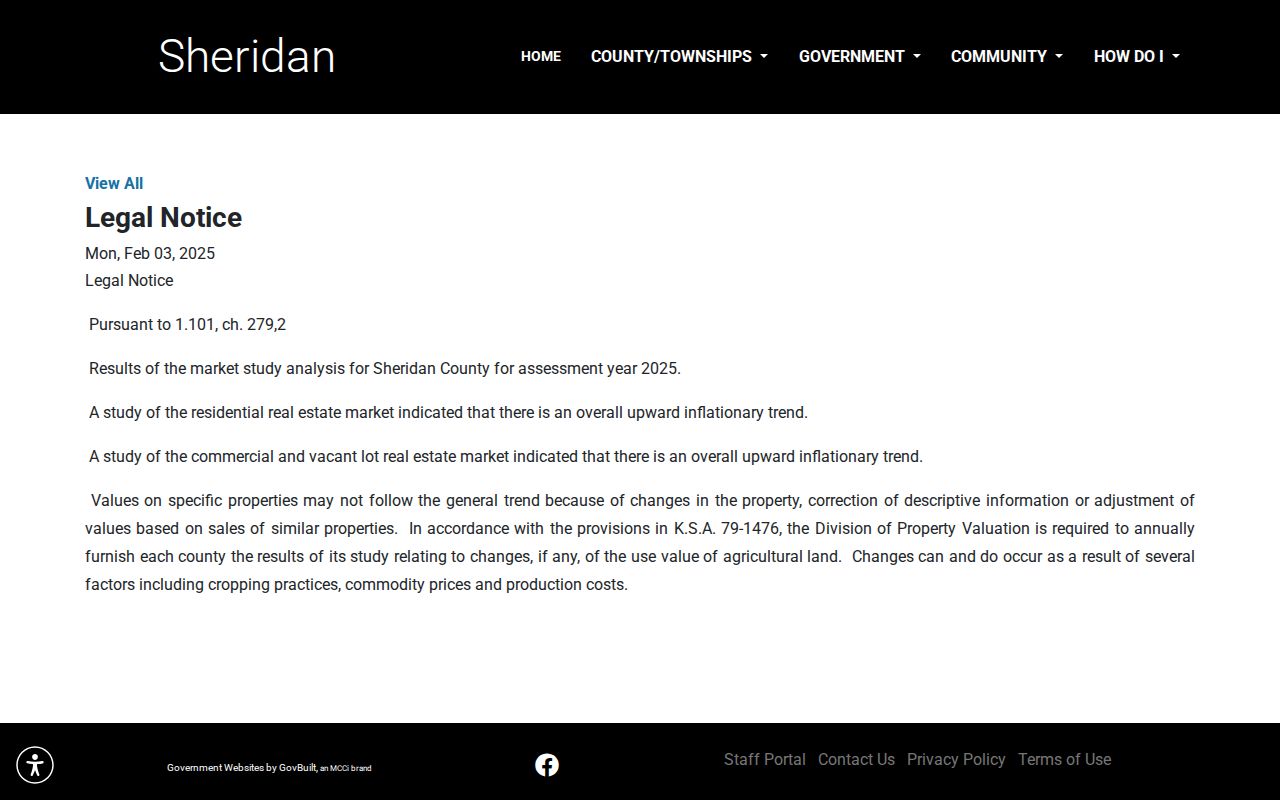
Treat these figures as trend context only. A countywide notice never settles one tract's value. Verify the individual parcel's own notice before drawing any conclusion about it.
January 2026 county minutes add a separate agricultural clue. The Appraiser discussed a proposed CAP Amendment along with an approximate countywide agricultural-land valuation decrease. Ask for the proposal itself, the affected land class, the method, and the parcel's notice before applying that discussion to a farm. One countywide number does not establish a single tract's result.
Sheridan County Delinquent Tax Records
Delinquency questions start with the County Treasurer. Kansas law shapes what a tax-sale list must contain. It names the owner of record and the legal description. It lists an address when one exists. It also gives the unpaid tax details, then requires publication. Sheridan County posts no complete online roster. Ask the office directly for the published notice, the tax year it covers, and the parcel-level record.
County minutes dated January 6, 2026 state that tax-foreclosure documents were filed January 1. The minutes themselves do not itemize parcels or case numbers. Request the filed case or document list from the County Attorney or the Clerk for that detail. From there, the 15th Judicial District record system carries the court side. The Register of Deeds holds any resulting recorded instrument.
Treat a published notice as a lead, not a payoff figure or proof of ownership. Match the tax year, owner-of-record name, legal description, and parcel account. Do this before tying the notice to land. Ask the Treasurer whether payment, redemption, a dismissal, or a new filing changed the outcome. Litigation leaves its trail in the court docket. A sheriff's deed or release that follows belongs in the recorder's land files.
Appeal a Sheridan County Assessment
Kansas counties generally mail valuation notices around March 1. The county equalization appeal is then due within 30 days of that mailing. Start with the County Appraiser and follow the deadline printed on the notice itself. Come prepared with the parcel record and its classification. Bring land and improvement details, comparable sales, and photographs. Include correction documents and a clear reason why a field or value is wrong.
If the county decision still rankles, another formal option exists. The Kansas Board of Tax Appeals offers the next route. It operates under its own current forms and deadlines. A payment-under-protest filing works differently and applies after the tax statement arrives. The Kansas Department of Revenue appeal page spells out the difference between the two routes. Confirm which path fits before filing anything.
For reference, two state pages describe the steps in full. The state appeal overview and the official Board of Tax Appeals process page each cover their respective routes.
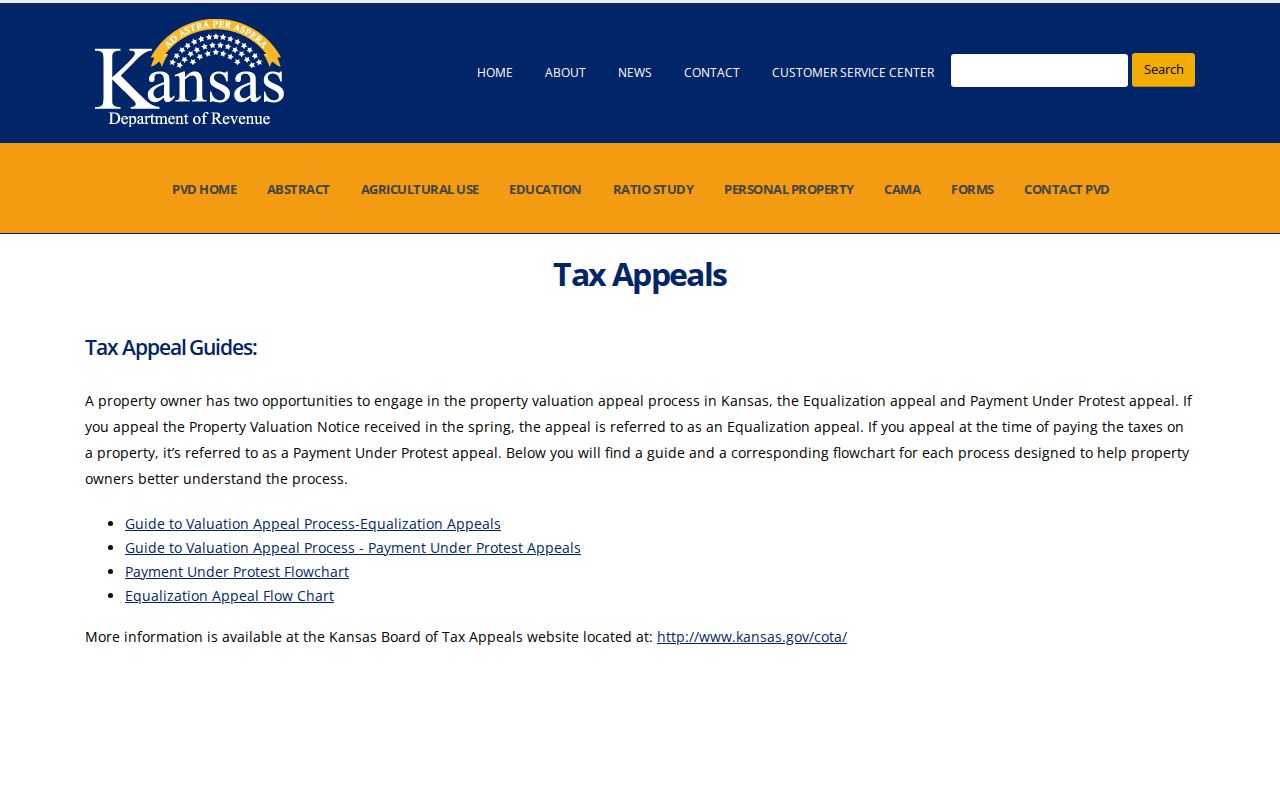
Kansas Revenue separates equalization appeals from payment under protest.
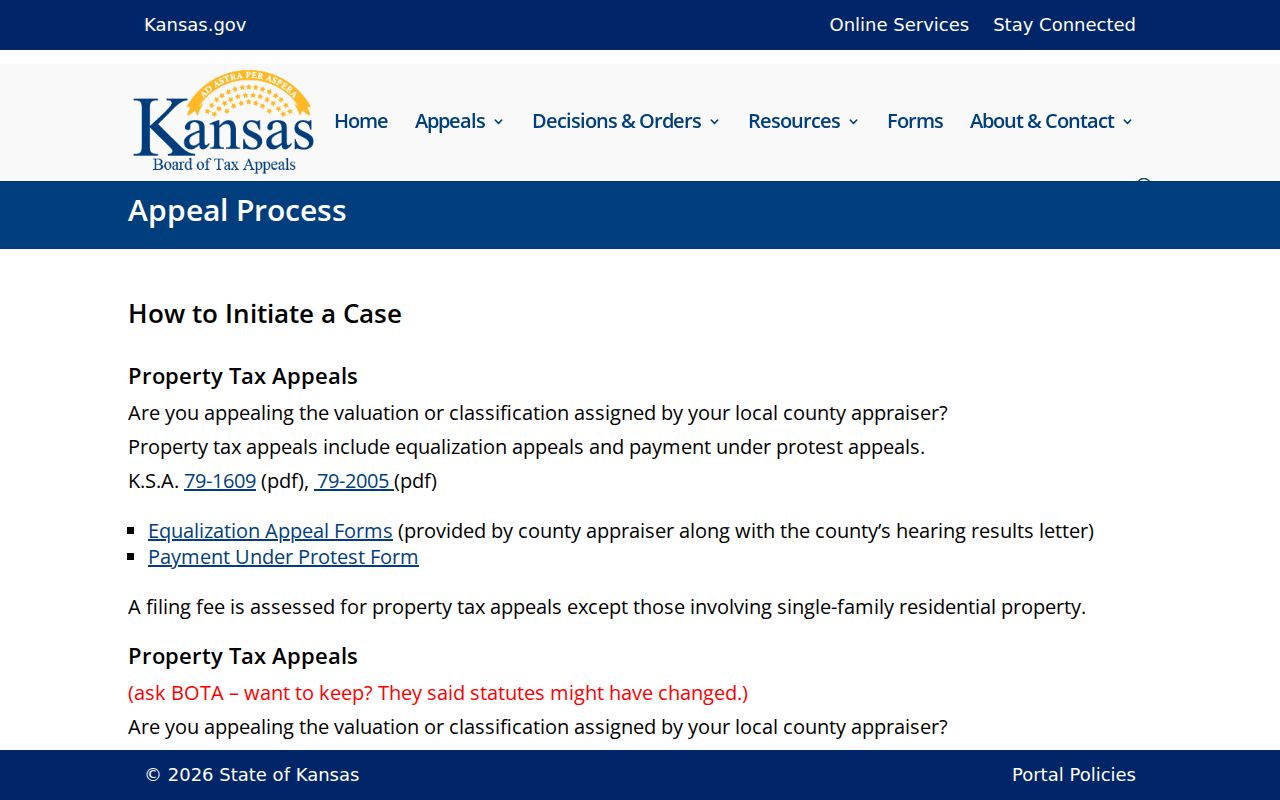
The Board of Tax Appeals page lays out the next formal step after the county-level appeal. Its current forms and deadlines govern that filing.
Appeal window. File the county equalization appeal within 30 days of the current notice's mailing date, and verify that date with the Appraiser.
Request Sheridan County Tax Files
When the payment site leaves a question open, request existing records by phone, email, mail, or at the counter. A strong packet gives the office the complete situs, parcel or account number, tax year, tax district, owner name as shown, and how you want delivery. Ask separately for the valuation record, the notice, statements, receipts, delinquency status, special assessments, added tax, and any protest filing.
The Kansas Open Records Act requires a response as soon as possible and within three business days. Otherwise the office must explain the delay or the denial. Sheridan County publishes no KORA fee schedule of its own. Ask for estimated copy and staff costs before work begins.
Counter inspection earns its keep when the question spans several years or the statement number is unknown. A quick phone call or email can pin down the right custodian and identifiers first. A written request then documents the years and fields you seek. Ask the office to name any withheld field and the reason for withholding it. KORA opens existing public records to inspection, but it does not force the county to calculate a fresh estimate or build a custom report.
Note: A tax mailing address is a delivery field and does not prove who lives at the property.