
Trace Sheridan County Former Owners
Start with the most recent recorded deed. Add one earlier transfer per row. This backward timeline keeps former owners tied to the same Sheridan County land even as names, street labels, and parcel numbers change.
| Transfer date | Grantor to grantee | Deed type | Book/page and land key |
|---|---|---|---|
| Most recent recording | Prior owner to present grantee | Type stated in the deed record | Current reference plus matching legal description |
| Earlier recording | Earlier grantor to that prior owner | Warranty, quitclaim, probate, sheriff's, or other deed | Matching lot/block or section/township/range |
| Repeat backward | Each seller traced to an acquiring deed | Note corrections and estate links | Preserve old PIN and plat references |
Names alone never form a chain. Match them to the land. The recording date, parties, deed type, and legal description must agree at each step before anyone counts among the property's prior owners.
Sheridan County's Office-First Deed Search
Sheridan County offers no public online grantor-grantee index or deed image portal. That makes the Register of Deeds staff page the sound starting point. Use it for a Sheridan County property search. The same official office listing names the local custodian of deed records. It also gives the best contact route. Skip third-party map shells that promise more than the county actually publishes.
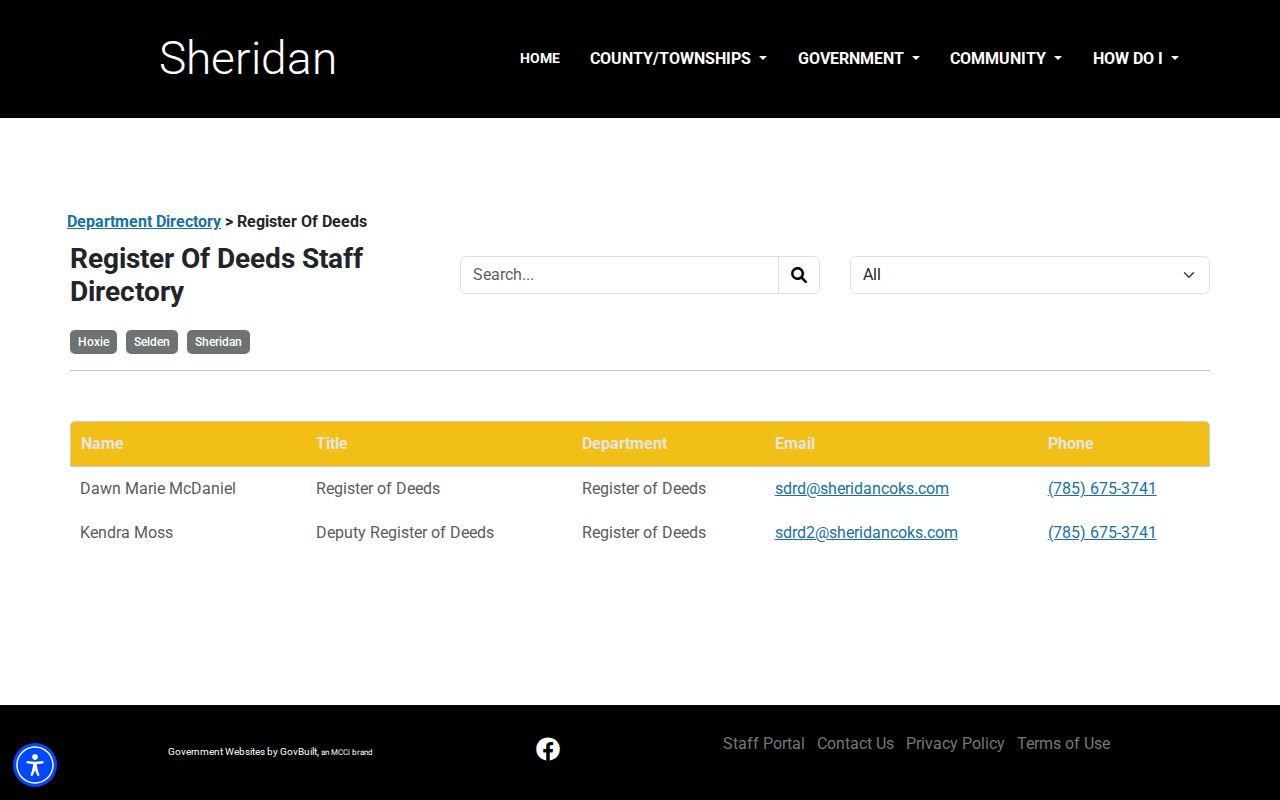
Use that verified contact rather than assuming the county offers a searchable deed-image portal.
Coverage matters. Ask which deed-book years are indexed or scanned and how staff provide references before assuming any historic period is online.
The Register of Deeds sits on the courthouse's second floor at 925 9th Street in Hoxie. Hours run Monday through Friday, 8:00 AM to 4:30 PM. Walk-in deed searches are welcome. Staff also take calls at (785) 675-3741, emails at sdrd@sheridancoks.com, and mailed requests at PO Box 899, Hoxie, KS 67740. Ask the office about copy fees first.
Sources for Sheridan County Prior Owners
The Register of Deeds holds the controlling instruments. Archives, the historical atlas, township assessments, and court files bridge older periods or estate transfers in Sheridan County.
| Record trail | Known period | Access point | Best evidence |
|---|---|---|---|
| Recorded deed chain | Coverage date not published | Register of Deeds counter, phone, email, or written KORA request | Grantor, grantee, legal description, deed type, and recording reference |
| Probate docket books | 1871-1950 | Kansas State Archives, microfilm MF 1039-1048 | Estate proceedings that may explain a transfer |
| Standard Atlas of Sheridan County | 1906-1907 | Kansas Historical Society, call number LM 496 no. 13 | Historic ownership-map and plat orientation |
| Township assessments | Selden 1906-1941; Kenneth 1909-1941 | FamilySearch catalogs and local museum capture | Historical taxpayer and improvement clues |
Use an old source for a name or land clue. Then return to the deed books for proof, since historical assessment and map entries never establish current title.
Reconstructing Sheridan County Ownership in Reverse
Open with the current conveyance, not a guessed historic name. Keep a separate line for every Sheridan County transfer and carry the exact legal description forward.
- Ask for the present owner's acquiring deed, with that owner searched as grantee.
- Copy the grantor, recording date, deed type, legal description, and book/page or instrument number.
- Search that grantor as an earlier grantee, then compare the land description before accepting the match.
- Repeat. If the chain enters an estate, foreclosure, split, or plat change, add the related probate, court, or plat reference.
- Grantor and grantee
- The conveying party and the party receiving the interest.
- Chain of title
- The ordered sequence of instruments affecting the same land.
- Reverse index
- An index organized by grantee, useful for locating how a seller first acquired the property.
- Warranty and quitclaim deed
- Different forms of conveyance; the label alone does not prove a complete title history.
Legal Descriptions Link Sheridan County Past Owners
A house number alone can sink old ownership research. Rural land carries a section, township, range, and quarter-section description. A town parcel uses townsite, addition, lot, and block. Follow the full legal description instead. The county's ArcGIS schema lists legal description, book and page, deed date, receipt number, current and old PIN fields, and split-history candidates. It does not resolve to a live Kansas parcel result. Treat those field names as a way to shape an Appraiser request, not as proof of an online chain of title.
Probate Dockets Bridge Sheridan County Previous Owners
Probate can interrupt a simple buyer-seller sequence. When an owner dies, the estate transfers the land. The Kansas State Archives finding aid identifies ten reels of Sheridan County probate docket books spanning 1871 through 1950. A docket may name the estate, its representative, the heirs, orders, and case references that explain why the next deed lists different parties. Probate remains supporting evidence, not the final title record. Match each docket to the recorded executor, administrator, or probate conveyance at the Register of Deeds.
The 1906 Atlas and Township Owner Clues
A KSHS catalog entry describes a Standard Atlas of Sheridan County published for 1906-1907, a plat book that can reveal who held each parcel at that date. Township-level records add more. FamilySearch catalogs assessment records for Selden Township covering 1906-1941, plus Kenneth Township records spanning 1909-1941.
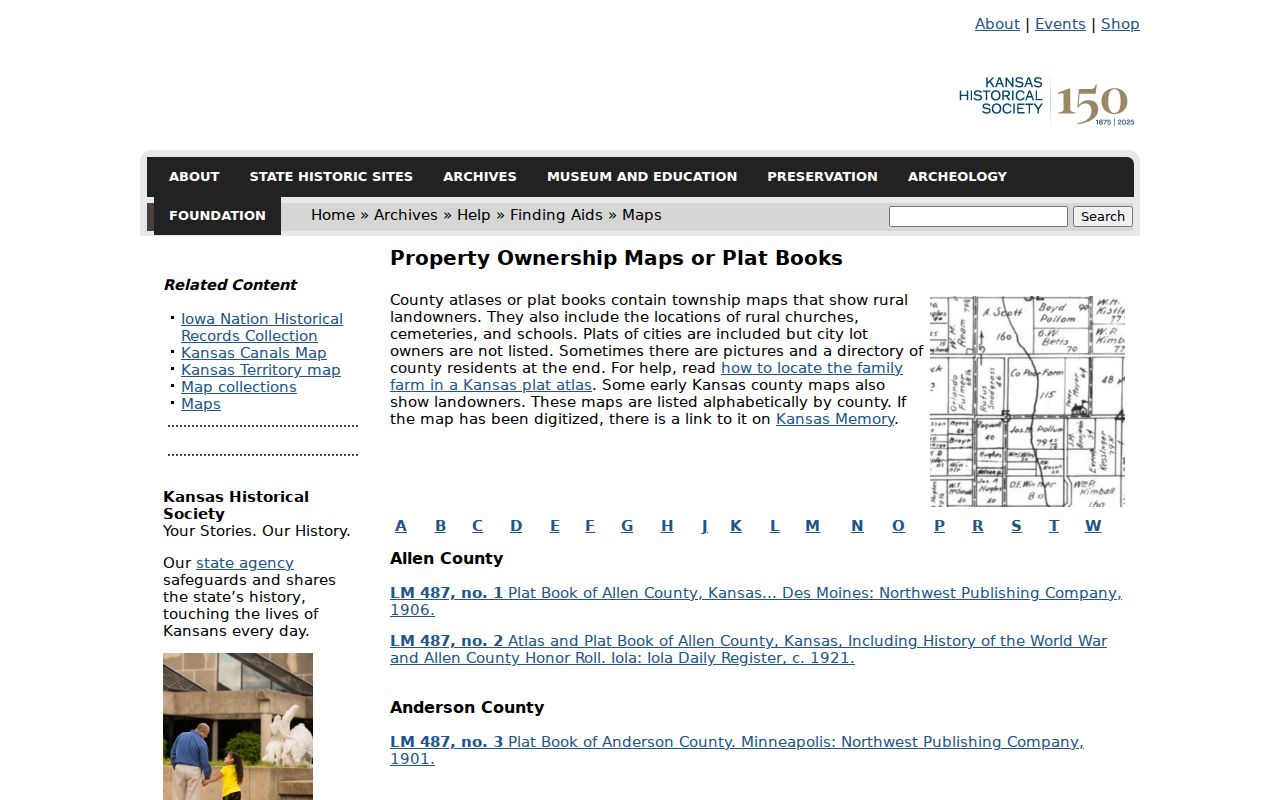
These sources orient a search by historic taxpayer, tract, or townsite when no modern address existed. They still do not replace a deed. Let a map label or assessment entry lead you back to the filed instrument.
Moved Buildings Create Sheridan County History Traps
Buildings and land do not always share one history. Hoxie grew out of Kenneth. Owners moved buildings toward the projected railroad route, and the town followed. Selden's history likewise ties families and structures to Old Sheridan, Shibboleth, and Jackson. A former owner can vanish under a modern town name. Search the older place in local histories, newspapers, atlases, and assessment books, and check whether a clue tracks the building, the land, or both before staff pull an older deed book.
Selden Newspapers Add Names, Not Title
Selden Public Library holds newspapers from 1889 through 1962. Those pages may carry a former street name, a moved-building account, a sale notice, a family name, or original town-company wording. That can unstick a stalled deed index search. Newsprint is not title evidence. A person called an owner might have been an occupant, a business operator, or a seller, so preserve the wording and confirm the conveyance in the deed records.
Preserved Sheridan County Deed Book Clues
A 2021 preservation report describes Sheridan County records processed through an ArcaSearch project. The project covers deeds, mortgages, notary records, mining claims, and miscellaneous volumes. Preservation happened. That alone does not mean the public can browse a deed image portal. It also does not guarantee access to every early year. Ask the Register of Deeds whether the scans sit at an office terminal, require staff retrieval, or exist only as preservation copies.
When staff locate a digitized book, note its title. Also note its date span, index type, and image-access rule. Search the direct index and the reverse index alike. A direct index tracks the grantor. A reverse index tracks the grantee. That split matters when you rebuild a chain of former owners, because the seller on one deed should appear as the buyer on an earlier one.
Never assume a missing image means the transfer never happened. The index may carry the next link. So may the deed book itself, a probate docket, a correction instrument, or a later reference. Keep spelling variants exactly as written, including the “Seldon” catalog spelling attached to some Selden material. Let the legal description settle whether a clue truly belongs to your tract.
How Far Sheridan County Ownership Records Reach
Sheridan County publishes no official earliest deed-book year, digitization cutoff, or destroyed-volume history. So the sensible stopping point is simply the oldest instrument staff can match to your tract. Older atlases, assessment rolls, probate files, and local-history materials can then extend the ownership search beyond the recorded chain.
Lawful use. Research prior owners for title, estate, purchase, or house-history work; never use records to follow, threaten, or harass a person.
A KORA request should name the Register of Deeds. It should also include the legal description and a date range. Kansas law opens inspection during regular hours, and it allows actual-cost charges for copies and staff time. Request existing index entries or images, not a new title opinion. Where legal reliance matters, order a professional title examination.